The Book That Has Been Waiting For Me
On writing Bloodline: Nectar, Grit, & God
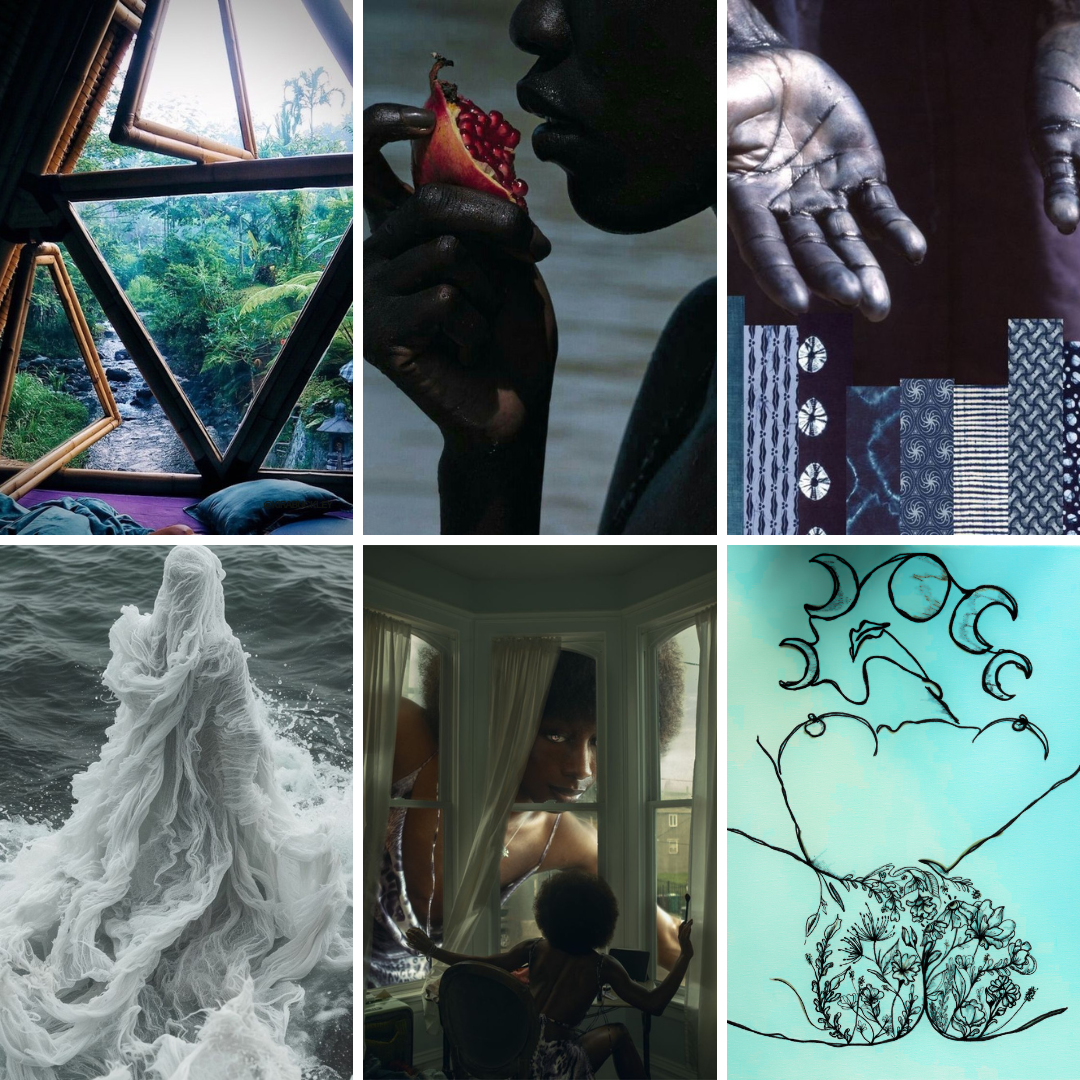
A Novel Moodboard | Kira Buckley
There is a particular kind of quiet that arrives when your life changes direction.
Not loudly.
Not with fireworks.
More like a door closing softly behind you while another one opens somewhere deeper inside the house.
That is what writing this novel has felt like.
For years, people have known me through healing work — acupuncture tables, ceremony circles, Rest Portals, plant medicine conversations, prayer spaces where people bring the tender parts of their lives to be witnessed.
That work shaped me.
But something else has always been living alongside it.
Language.
Story.
The impulse to translate the interior lives of women — especially Black women — into something that breathes on the page.
For a long time I thought writing was something I would eventually get around to.
What I didn’t understand then is that the book had already begun writing me.
The Origin of Bloodline
The novel I’m writing now is called: {oh, you’ll have to join the writing village for this detail…}
It lives somewhere between literary fiction, spiritual memoir, and Afro-futurist cosmology. But labels don’t fully explain what it is. At its core, the book asks a very simple question:
What happens when a woman stops pretending she is only one thing?
The story unfolds through six women — six archetypes of a single soul gathered together for a spiritual reckoning. …
They are not separate characters in the usual sense. They are internal presences. Living dimensions of the same consciousness. Six voices that argue, collaborate, confess, remember, and confront one another. Together they form what I think of as a soul mandala. A hexagon. Six corners of a spiritual home. Each woman represents a way of being alive.
The Six Women
There is the Mother — the one who births everything. Children, ideas, grief, rituals, responsibility.
There is the Lover — sensual, dangerous, and unashamed of desire.
The Priestess — the one who hears the ancestors long before anyone else admits they are speaking.
The Rebel — the woman who leaves, who refuses the rules, who chooses movement over approval.
The Intellectual — the strategist who dissects systems and sharpens truth into language.
And finally the Mystic Elder — the one who remembers past and future at the same time.
These women collide inside the story. They interrupt each other. They challenge each other. They refuse to flatten themselves into something polite or understandable. And slowly they begin to realize something none of them expected: They are not competing.
They are the same woman learning how to live with her own multiplicity.
Where the Story Begins
The novel opens at dawn in the jungle. The narrator is building an altar. Not for a public ceremony. Not for a crowd. For herself.
Six objects sit on the altar — each representing one of the women who live inside her.
A rattle.
A mirror and key.
A feathered thread.
A broken chain.
A fountain pen.
A compass and cowrie shell.
She places each object carefully. Then she says something simple. Something that changes everything.
“Come forth.
All of you.
I am ready now.”
And one by one, they arrive.
The Mother enters with the scent of salt and tea leaves. The Lover stretches out like a secret she’s been waiting to tell. The Priestess steps through smoke. The Rebel slams the door open with plum lipstick and unapologetic space-taking. The Intellectual appears as if she has always been sitting there. And finally the Mystic Elder arrives — bringing a silence so deep even the crickets stop singing.
The altar flares.
The ancestors pull up chairs.
And the real work begins.
Why This Story Matters To Me
For generations, Black women have been asked to simplify themselves. To pick one role.
Mother.
Caretaker.
Professional.
Lover.
Healer.
But the truth is that we contain entire constellations of selves. We hold rebellion and devotion in the same body. We carry churches and wildfires in the same bloodstream. This novel refuses the idea that we must shrink ourselves into a single version of womanhood. Instead, it asks:
What if our complexity is the medicine?
What if every archetype inside us has something sacred to say?
The Lineage Behind the Book
Like most books that matter, this one is not being written alone. I am writing inside a literary lineage that made space for voices like mine to exist. Writers like Audre Lorde, who taught us that the erotic is power. bell hooks, who insisted that love and liberation belong in the same sentence. Octavia Butler, who proved that Black women could build entire futures from imagination. And even the teenage moment when my uncle handed me Flyy Girl by Omar Tyree and I realized that a Black girl’s interior life could be written with honesty and electricity. Those voices stand behind this book. They remind me that stories are not simply entertainment. They are architecture. They build worlds people can live inside.
Writing As Ceremony
I’ve come to understand that writing this novel is not separate from my healing work. It is another form of it. Each sentence feels like placing a brick inside something sacred. A cathedral made of breath and memory. Sometimes the writing is exhilarating. Sometimes it is exhausting. Sometimes it opens emotional doors I didn’t realize were still closed. But that is the work. To sanctify memory. To mythologize survival. To write the kind of story that lets other people recognize themselves inside it.
What Comes Next
Right now the book is still in its early chapters; circulating quietly among a small writing village — readers who have chosen to witness the story as it grows. Their excitement has reminded me that books are never created alone. They are built in community. Over the next months I’ll continue sharing glimpses of the writing here on the blog — reflections, excerpts, and the strange moments when characters begin to feel more real than the person typing their words. Eventually the full story will arrive. But for now, we are still inside the beginning.
And beginnings are sacred.
A Quiet Invitation
If this story resonates with something in you… If you recognize parts of yourself inside these archetypes… If you believe stories have the power to heal memory and shape the future… Then you are already part of this book’s field. Thank you for being here while it becomes.
With love and steadiness,
Kira
Currently Writing:
Chapter 4 — The Rebel Speaks